If you are a property owner in the St. Louis metro area and you have decided to clean up a biohazard scene yourself with household bleach, you are about to make a $50,000 mistake. That is the average cost of full structural remediation after a failed DIY attempt, not counting the long-term health liabilities for you and your tenants. The chemical reaction between bleach and organic matter actually releases toxic chloramine gas, and the residual biological material left behind will continue to emit pathogens that can cause respiratory infections months later. Professional emergency biohazard cleanup services near Downtown St. Louis are not a luxury; they are a legally mandated safety requirement under OSHA 29 CFR 1910.1030 and the IICRC S540 standard.
St. Louis Biohazard Cleanup has been the region’s leading provider of trauma and crime scene remediation for over a decade. We understand the unique challenges of the local environment: the humid summer months that accelerate decomposition, the porous brick foundations common in older downtown buildings, and the strict waste transport regulations enforced by the Missouri Department of Natural Resources. Whether you are dealing with a recent incident or a long-unattended scene, our certified technicians bring the equipment, the training, and the compassion to restore your property safely and completely.
Technical Remediation Process: From Assessment to Structural Clearance
Every emergency biohazard cleanup begins with a site risk assessment conducted by a certified supervisor. We identify all affected zones, including hidden seepage into floor joists or behind wall cavities. The team then establishes a containment perimeter using negative air pressure machines rated at 1,500 cubic feet per minute to prevent airborne contaminants from migrating to adjacent rooms. This is particularly critical in downtown St. Louis row houses where shared walls can transmit pathogens to neighboring units.
Once containment is secured, all visible biohazardous material is removed manually using hospital-grade absorbents and specialized enzyme treatments that break down proteins at the molecular level. The area is then scrubbed with EPA-registered disinfectants approved for bloodborne pathogens (e.g., sodium hypochlorite solutions at 10% concentration, per CDC guidelines). After the initial cleaning, we perform adenosine triphosphate (ATP) fluorescence testing to verify that no organic residue remains. If the test fails, the process is repeated until the surface meets the IICRC standard of fewer than 10 relative light units per swabbed area.
Structural materials that cannot be decontaminated—such as saturated drywall, carpet padding, or insulation—are removed and replaced. For porous materials like unsealed brick or grout, we apply a penetrating antimicrobial sealant that creates a permanent barrier. Finally, the entire workspace undergoes a third ATP test, and the area is fogged with a sporicidal disinfectant to eliminate any airborne microbial spores. This protocol exceeds the requirements for most commercial insurance policies and ensures the property is safe for reoccupation.
Professional Remediation vs. Standard Janitorial Cleaning
Many property managers mistakenly believe that a deep cleaning crew can handle a biohazard scene. The following table illustrates the critical differences.
| Feature / Metric | Professional Biohazard Remediation | Standard Residential Cleaning |
|---|---|---|
| Regulatory Compliance | Full adherence to OSHA 29 CFR 1910.1030, EPA FIFRA, and DOT waste transport rules | No compliance; can result in fines up to $70,000 per violation |
| Pathogen Elimination | ATP fluorescence testing verifies 99.99% reduction of hepatitis B, HIV, and MRSA | Visual inspection only; >90% of pathogens often remain |
| Structural Assessment | Thermal imaging and moisture meters detect hidden biological seepage | No assessment; hidden contamination leads to mold and odor |
| Waste Disposal | Licensed biohazard waste transport with incineration at a permitted facility | Illegal dumping or improper disposal; potential criminal liability |
| Insurance Coverage | Work can be billed directly to property insurance; detailed documentation provided | No documentation; insurance claims denied |
| Odor Elimination | Industrial ozone generators and hydroxyl machines neutralize volatile organic compounds | Air fresheners mask odor; bacteria continue to proliferate |
Expert Insights: Three Diagnostic Tips Every Property Owner Should Know
Professional technicians use advanced diagnostic methods that go far beyond what the eye can see. First, thermal imaging cameras detect temperature variations caused by biological decomposition behind walls. A 2-degree Fahrenheit difference often indicates active microbial growth that requires wall removal. Second, moisture meters with deep-sensing probes measure the moisture content of subflooring and joists. Any reading above 16% suggests biological fluid penetration, and the material must be replaced, not cleaned. Third, ATP swabs provide a quantitative measure of organic residue. A reading above 30 RLU on a non-porous surface after cleaning indicates failed decontamination that can lead to infection risks.
Common mistakes that property owners make include using household bleach on bodily fluids—this denatures proteins but does not eliminate all viruses, and the chlorine gas exacerbates respiratory issues. Another mistake is waiting for the odor to dissipate naturally. In St. Louis’s humid climate, odor molecules bind to porous surfaces and can persist for years, attracting pests and causing ongoing health complaints. Finally, allowing untrained maintenance staff or family members into the site before professional remediation can spread pathogens throughout the building, turning a single-room incident into a whole-house contamination.
Pricing Structure for Emergency Biohazard Cleanup in Downtown St. Louis
Costs for emergency biohazard cleanup services vary based on the scope of the incident, but we provide transparent pricing so you can plan ahead. Typical charges include:
- Site mobilization fee: $350–$750 covers the initial response, vehicle fuel, and basic PPE setup. This is a one-time charge per incident.
- Hourly remediation rate: $150–$300 per hour, per technician. Most scenes require a two-person crew for 4–8 hours. Complex cases, such as decomposed remains, may require 20+ hours.
- Biohazardous waste disposal: $25–$75 per pound of regulated medical waste. The weight depends on the volume of contaminated materials (e.g., saturated carpet, furniture, porous items).
- Structural decontamination: $1,500–$5,000 for sealing, replacing drywall, or treating HVAC systems if airborne contamination is detected.
Three factors that most influence the final cost are the extent of structural material replacement needed (e.g., subflooring vs. basement walls), the total volume of biohazardous waste (which affects disposal fees), and whether specialized HVAC decontamination is required to prevent cross-contamination through ductwork.
Safety Standards and Certifications
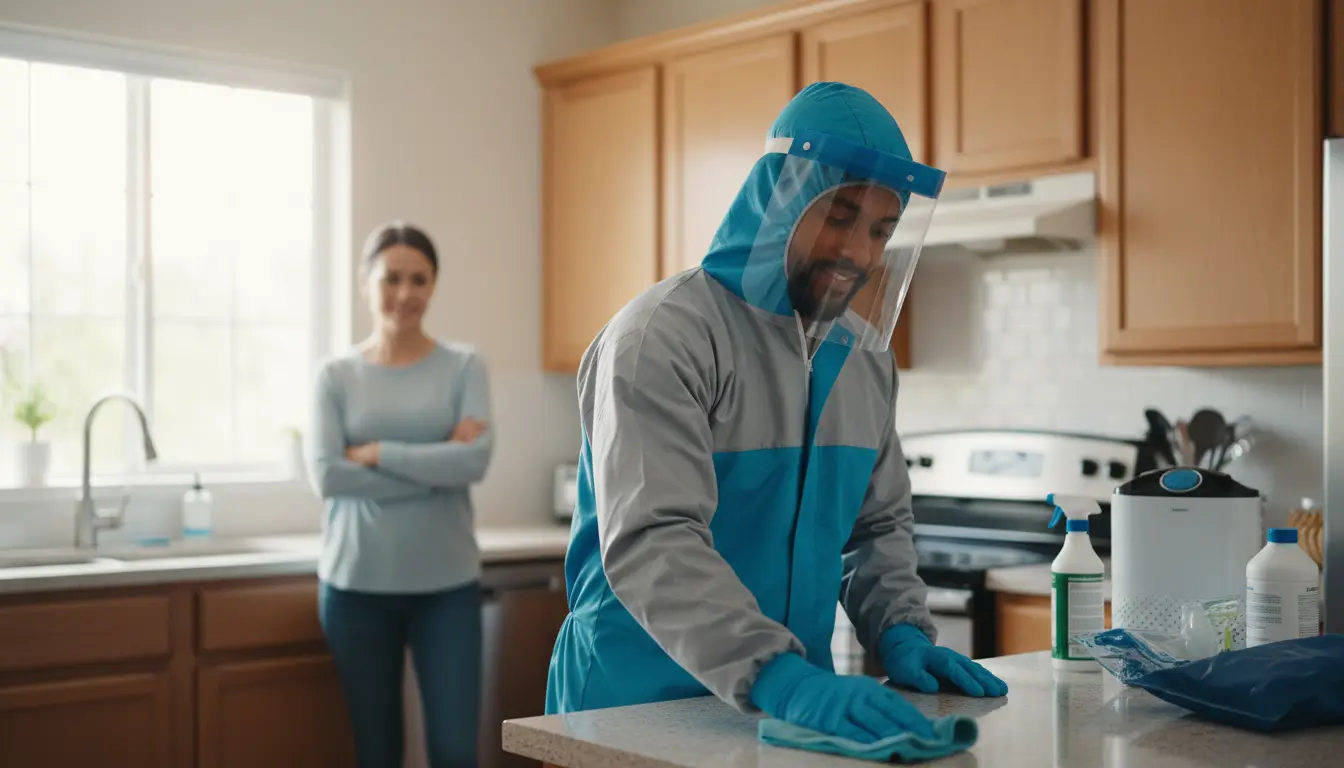
Our technicians hold current certifications in the IICRC S540 standard for trauma and crime scene cleanup, as well as the OSHA Bloodborne Pathogens Standard 29 CFR 1910.1030. Every team member is trained in proper PPE protocols—Tyvek suits, P100 respirators, face shields, and puncture-resistant gloves—and is vaccinated against hepatitis B. We also maintain a strict chain of custody for all biohazardous waste, which is transported by licensed carriers to a permitted incinerator in Missouri. This process protects not only the cleanup crew but also the property owner from future liability. If your property is ever inspected by the city or a future buyer, we provide a detailed remediation report that demonstrates compliance with all applicable regulations.
Frequently Asked Questions About Biohazard Remediation
How soon after an incident should I call for cleanup?
Immediately—within hours if possible. Biological fluids begin to degrade within 30 minutes, releasing volatile organic compounds that can permeate porous surfaces. The longer the delay, the more extensive the contamination and the higher the cost. In St. Louis’s summer heat, decomposition accelerates, and within 24 hours, blood can seep into concrete and drywall, requiring replacement of those materials.
Can I stay in my home while the cleanup is happening?
No. For safety, the affected area must be isolated with negative air pressure, and the rest of the home should be vacated during the remediation. The process often involves the use of chemical disinfectants and ozone generators that can be hazardous to humans and pets. We recommend securing alternative lodging for 24–48 hours, depending on the scope of the work.
Will my insurance cover the cost of emergency biohazard cleanup?
Most homeowners’ and commercial property insurance policies cover sudden and accidental damage, including biohazard cleanup. We work directly with your insurance adjuster, providing detailed documentation and photographs that support your claim. It is important to notify your insurer as soon as possible and to avoid cleaning the site yourself, as that can void coverage.
What is the difference between biohazard remediation and regular cleaning?
Biohazard remediation is a regulated process that involves the removal, disinfection, and structural restoration of a site contaminated with blood, bodily fluids, or other potentially infectious materials. Standard cleaning services are not trained in pathogen elimination, do not use ATP testing, and cannot legally dispose of biohazardous waste. Using a non-professional service can result in health code violations, fines, and long-term health risks for occupants.
How do you handle odors after a trauma scene?
Odor elimination is a multi-step process. After all visible contamination is removed, we use hydroxyl generators and ozone machines to oxidize the volatile organic compounds (VOCs) that cause smell. For porous surfaces, we apply an enzyme-based odor neutralizer that breaks down the organic material at the molecular level. Finally, we conduct a smell test using non-detectable instruments to ensure the air is odor-free before the property is deemed safe.
Professional Biohazard Remediation in St. Louis
When you face a biohazard incident in your property, the decision to call a certified professional is not just about cleanliness—it is about protecting your health, your investment, and your peace of mind. St. Louis Biohazard Cleanup combines rigorous technical expertise with compassionate, respectful service. We understand the emotional weight of these situations, and we handle every job with discretion and efficiency. Our team is available 24/7, ready to respond to any emergency across the metro area. Do not risk a DIY approach or a substandard cleaning service. Contact us today for a free, no-obligation assessment and let us restore your property to a safe, livable condition.