The technician’s HEPA-equipped vacuum hummed steadily in the corner of a Clayton basement as a thermal imaging camera revealed a slow, persistent dampness seeping through the brick foundation. The homeowner had only noticed a musty smell three days after a minor pipe leak, but the instrument told a different story—one of hidden biological activity already colonizing the porous mortar. That moment, captured during a routine assessment, underscores why the latest biohazard cleanup standards and safety practices (2026) no longer rely on guesswork or surface-level cleaning.
In St. Louis, where a mix of historic brick homes and modern developments creates unique structural challenges, the move toward science-driven remediation has become essential. Seasonal humidity swings and aging infrastructure mean that biological hazards—whether from a trauma event, unattended decomposition, or flood-related contamination—can penetrate far deeper than what meets the eye. Without strict adherence to updated protocols, property owners risk long-term health consequences and significant structural damage. This article examines the 2026 standards that define professional remediation today and why local expertise matters when safety is on the line.
The Shift Toward Evidence-Based Remediation Protocols
The days of relying solely on visual inspection and bleach-based cleaning are over. The latest biohazard cleanup standards and safety practices (2026) emphasize what the industry calls “forensic restoration”—a methodical process that begins with identifying every potential reservoir of contamination before any physical removal starts. Standards bodies such as the IICRC and OSHA now explicitly require environmental assessments using diagnostic tools, not just human senses.
For St. Louis properties, this shift is especially relevant. The region’s older homes often feature unsealed brick, plaster-and-lath walls, and hardwood subfloors that can trap biological material. A floor that looks clean to the naked eye may still harbor pathogens beneath the surface. Professional teams now use adenosine triphosphate testing, or ATP fluorescence swabbing, to measure organic residue at the molecular level. If the ATP reading exceeds a defined threshold, the area is re-cleaned and retested before clearance is issued. This approach aligns with healthcare-grade disinfection standards and moves residential remediation closer to hospital-level rigor.
Step-by-Step Professional Remediation Workflow
Initial Risk Assessment and Site Control
Every job begins with a zone-based risk assessment. The technician establishes a containment perimeter using polyethylene sheeting and negative air machines that create pressure differentials. This prevents airborne pathogens from migrating into unaffected areas of the home or building. For multi-unit structures common in neighborhoods like Lafayette Square or the Central West End, this step is critical to avoid cross-contamination between units.
The assessment also includes a moisture mapping survey. Given St. Louis’s seasonal extremes—humid summers and freezing winters—moisture levels can fluctuate dramatically. A trauma scene or biohazard spill in July will accelerate microbial growth far faster than the same event in January. Technicians record baseline moisture readings on every surface, from drywall to subfloor, and use that data to determine which materials can be salvaged through structural decontamination and which must be removed entirely.
Personal Protective Equipment and Engineering Controls
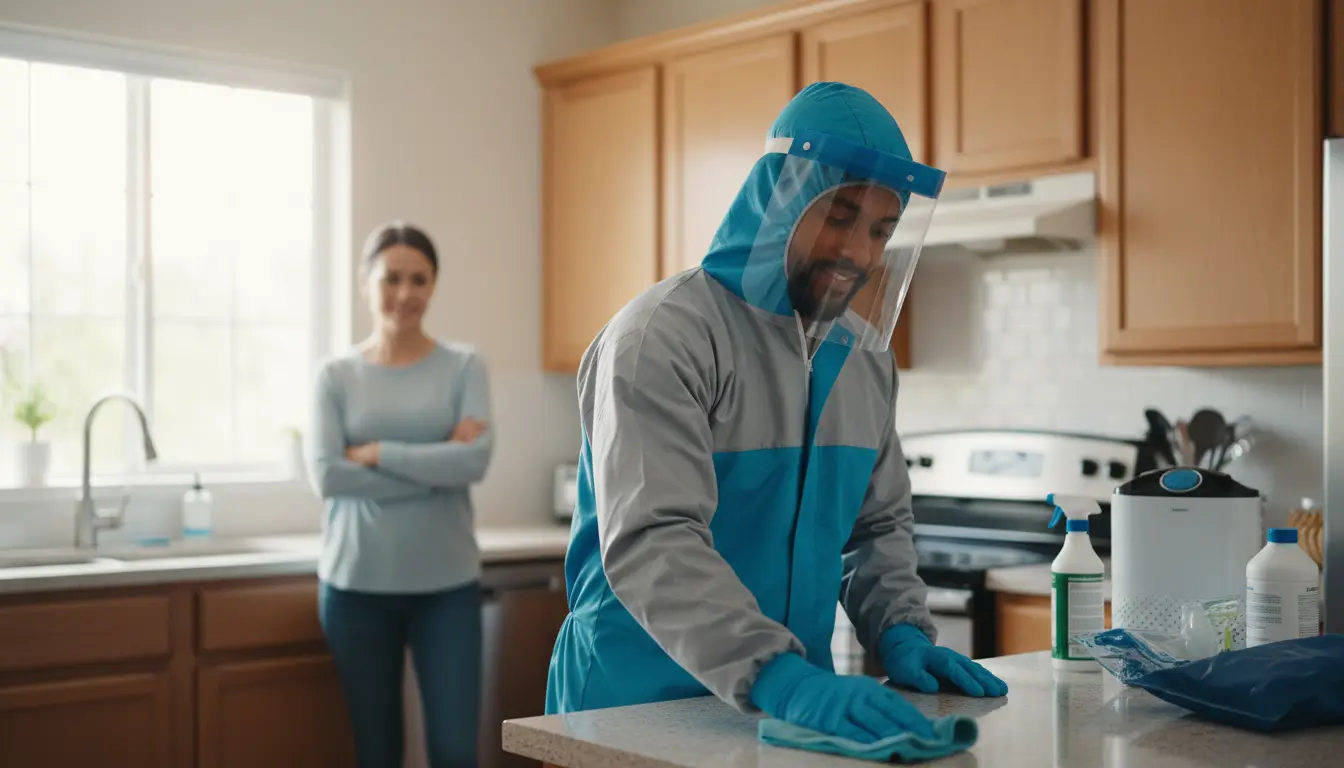
Protecting the remediation team is non-negotiable. The 2026 standards mandate full-body Tyvek suits, double-gloved hands, P100 respirators, and face shields for any scene involving bloodborne pathogens or airborne biological particles. This kit is not merely precautionary; it is a direct response to documented cases where untrained cleaners contracted illnesses after exposure to untreated sites.
Beyond personal gear, engineering controls have advanced significantly. Industrial-grade negative air machines equipped with HEPA filtration run continuously during active remediation. These units scrub the air at a rate of six to twelve air changes per hour, capturing particles as small as 0.3 microns. In a St. Louis row house with shared ventilation, this prevents contaminants from seeping into neighboring spaces.
Physical Removal and Chemical Sanitization
All visible biological material is physically removed using disposable tools and containment bags. Technicians then apply EPA-registered hospital-grade disinfectants specifically formulated to inactivate a broad spectrum of pathogens, including hepatitis B, hepatitis C, HIV, and methicillin-resistant staphylococcus aureus. These disinfectants must maintain a specific dwell time—typically ten to fifteen minutes—to achieve full viral inactivation. Rushing this step is one of the most common mistakes that leads to recurrent contamination.
For porous surfaces such as unsealed brick or old-growth timber, chemical cleaning alone may not suffice. In those cases, the latest standards call for structural encapsulation using specialized sealants that lock in any residual biological material. This is not a shortcut; it is a scientifically validated method to render a surface safe when complete removal would compromise the building’s structural integrity.
Verification and Clearance Testing
After cleaning and sanitization, the site undergoes ATP fluorescence testing and, in some cases, microbial air sampling. These tests confirm that the space meets the established safety thresholds. Documentation of every test result is now standard practice, providing property owners with verifiable proof that the site is safe for reoccupation. For insurance claims or real estate transactions, this paper trail can be invaluable.
Professional Remediation vs. Standard Cleaning: A Comparative Look
The table below highlights how professional biohazard remediation differs from standard residential cleaning across key performance metrics.
| Feature / Metric | Professional Biohazard Remediation | Standard Residential Cleaning |
|---|---|---|
| Regulatory Compliance | Follows IICRC S540, OSHA 29 CFR 1910.1030, and EPA biocide registration requirements | No regulated standard; cleaning solutions may not be EPA-registered |
| Pathogen Elimination Rate | 99.9% or higher verified via ATP testing and microbial air sampling | Variable; household disinfectants often fail against bloodborne pathogens |
| Structural Assessment | Includes moisture mapping, thermal imaging, and porous-material evaluation | Visual only; hidden contamination is frequently missed |
| Cross-Contamination Prevention | Negative air pressure, HEPA filtration, and sealed containment zones | No containment; airborne pathogens can spread to adjacent rooms |
| Waste Disposal | Biohazard waste properly labeled, transported, and incinerated per federal and state law | General trash pickup; illegal and dangerous for biological waste |
Source: IICRC S540 Trauma and Crime Scene Cleanup Standard
Expert Insights into Advanced Diagnostics
Experienced remediators now rely on three diagnostic methods that were uncommon in the field just five years ago. First, thermal imaging cameras detect temperature differentials behind walls and under flooring that indicate microbial metabolism. A spot that is two degrees warmer than its surroundings often points to an active colony. Second, borescopes allow technicians to inspect crawlspaces, wall cavities, and ductwork without destructive demolition. This tool is indispensable for St. Louis homes with balloon-frame construction, where biological fluids can migrate several floors away from the original incident. Third, real-time particle counters measure airborne particulate levels before, during, and after remediation, ensuring that the air quality meets or exceeds indoor standards before the containment is dismantled.
Another critical insight involves porous materials. Contrary to popular belief, cleaning porous surfaces like unsealed brick or aged hardwood with bleach or detergent does not eliminate pathogens. The liquid may kill surface-level bacteria, but the cellular structure of the material allows biological material to wick inward. Once inside, it can reactivate when moisture returns—a condition common in St. Louis basements during humid summer months. The 2026 standards are explicit: porous materials that have been contaminated with blood or bodily fluids must be physically removed and replaced, or encapsulated with an approved sealant, to achieve a safe outcome.
Common Mistakes Property Owners Make
Despite widespread awareness, property owners still fall into predictable traps. One frequent error is using household bleach on biological matter. Bleach is rapidly deactivated by organic material, meaning it loses efficacy within minutes of contact. The result is a surface that looks clean but still harbors viable pathogens. A second mistake is waiting for odors to dissipate naturally. Decomposition odors are caused by volatile organic compounds released as tissue breaks down. These compounds are often toxic and can be absorbed into drywall, carpet, and HVAC systems. Waiting merely allows the contamination to spread further.
A third and potentially more dangerous mistake is allowing untrained family members or employees into the site before professional remediation. Exposure to bloodborne pathogens can cause life-long health issues, and many homeowners do not realize that simply walking through a room can aerosolize dried biological material. These errors underscore why professional intervention is not a luxury—it is a public health necessity.
Pricing Structures for Biohazard Remediation
Understanding the cost of professional remediation helps property owners make informed decisions without hesitation. While every site is different, pricing generally breaks down into a few common categories:
- Site mobilization and assessment fee: This covers the initial visit, diagnostic testing, containment setup, and development of a remediation plan. It typically ranges from a few hundred to over a thousand dollars depending on the complexity of the site and its location within the metro area.
- Hourly remediation rates: Once the plan is in motion, the team charges on an hourly or per-square-foot basis. Rates reflect the specialized training of the technicians, the cost of PPE, and the use of HEPA filtration and negative air equipment. A straightforward trauma scene may require four to eight hours of labor, while a prolonged decomposition event can demand two or three days of continuous work.
- Specialized waste disposal fees: Biohazard waste cannot go to a standard landfill. It must be transported to an authorized medical waste incinerator. Disposal costs are calculated by weight and volume, and they can add a significant line item to the final invoice, especially when structural materials like flooring and drywall must be removed.
Three primary factors influence the final cost: the extent of structural material replacement required (replacing subflooring is more expensive than cleaning a concrete slab), the total volume of biohazardous waste generated, and the necessity for specialized HVAC decontamination if the system has been compromised. Property owners should always request a written estimate that itemizes these elements.
Safety Standards and Certifications That Matter
The foundation of every safe remediation is the regulatory framework that governs it. The most referenced standards in the 2026 landscape are the IICRC S540 standard for trauma and crime scene cleanup and OSHA’s Bloodborne Pathogens Standard, 29 CFR 1910.1030. These documents prescribe everything from the type of PPE required to the proper disposal of sharps and contaminated materials. Compliance is not optional; it is the baseline for any legitimate operation.
For St. Louis property owners, selecting a provider that holds IICRC certification and trains its staff under OSHA guidelines provides a layer of protection. It means that the crew knows how to handle hazardous waste manifests, how to decontaminate tools between rooms, and how to work with local law enforcement when a scene is part of an active investigation. Without these credentials, there is no guarantee that the work meets legal or health standards.
Additionally, authorized waste management services must be used for all disposal. Missouri regulations require that biohazard waste be tracked from the point of generation to the point of destruction. A certified provider will issue a waste tracking document for every load, giving property owners proof that the materials were handled lawfully.
Frequently Asked Questions About Biohazard Remediation
What makes professional biohazard cleanup different from a regular cleaning service?
Professional biohazard remediation follows a clinical, regulated workflow designed to eliminate pathogens down to the molecular level. Standard cleaning services lack the training, equipment, and EPA-registered disinfectants needed to neutralize bloodborne pathogens or safely dispose of biological waste. The 2026 standards are built on scientific verification, not just visual appearance, so a site is only cleared after passing ATP fluorescence and microbial air sampling tests.
How soon should I call a biohazard remediation company after discovering a contamination?
Immediately. Biological material begins to break down within hours, releasing volatile organic compounds and promoting microbial growth. In St. Louis’s humid climate, the window for safe, complete remediation narrows quickly. Waiting even 24 hours can turn a contained spill into a structural contamination that requires extensive demolition. Emergency response teams are available around the clock specifically because time is critical.
Can I clean a small biological spill myself with household products?
No. Household bleach and cleaners are not formulated to handle bloodborne pathogens. They lose efficacy in the presence of organic material and can create dangerous fumes when mixed with other chemicals. Furthermore, disposal of contaminated rags, sponges, or gloves is regulated. Throwing them in household trash is illegal in Missouri and poses a risk to sanitation workers. Professional remediation ensures that every contaminated item is handled and disposed of in full compliance with the law.
How do I know if a remediation company is qualified to handle biohazard scenes?
Look for IICRC certification in trauma and crime scene cleanup, proof of OSHA bloodborne pathogen training for all technicians, and a clear written protocol that includes ATP testing and final clearance documentation. A qualified company will also hold a valid Missouri waste transporter license for biohazardous materials. Asking for these credentials upfront is a reasonable and necessary step before allowing a team into your property.
Professional Biohazard Remediation in St. Louis
When a property is compromised by biological contamination, the margin for error is nonexistent. The latest biohazard cleanup standards and safety practices (2026) leave no room for shortcuts or guesswork—every step, from initial thermal imaging to final ATP clearance, is designed to protect both the occupants and the structure itself. In St. Louis, where weather patterns and older construction create additional hurdles, relying on a team that understands both the science and the local conditions is the only sensible path forward.
The technicians at St. Louis Biohazard Cleanup are certified, insured, and equipped with the diagnostic tools and industrial-grade systems that modern standards demand. They treat every site with discretion, urgency, and a focus on restoring safety without disruption to the surrounding community. Whether you are dealing with a recent trauma scene, a long-unattended biohazard, or the aftermath of a flood, having a trusted expert handle the process from assessment to final documentation brings peace of mind that a DIY approach can never match.
If you own or manage a property in St. Louis and need professional biohazard remediation, the safest decision you can make is to call in the specialists. The standards have changed, and the risks of ignoring them have never been higher. St. Louis Biohazard Cleanup is ready to respond.